The Turnbull Gamble by Wayne Errington
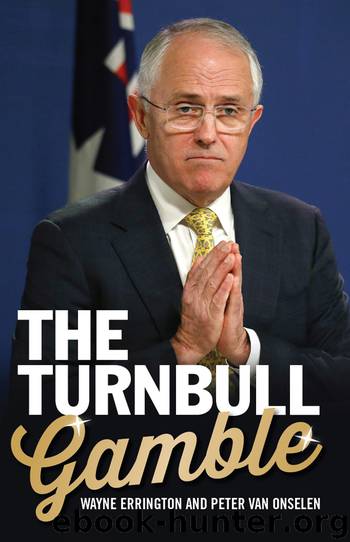
Author:Wayne Errington
Language: eng
Format: epub
ISBN: 9780522870749
Publisher: Melbourne University Publishing
Published: 2016-12-08T16:00:00+00:00
Five
DOUBLING DOWN
THE MOMENTS THAT define political careers tend to be the big decisions—whether about policy or political strategy. John Howard always discussed his biggest decisions with his family, his close advisers and his cabinet (although the latter wasn’t always the first port of call). A defining element of Howard’s success was the bitter experience of his first stint as leader when consultation wasn’t a strength. Consultation matters. Consultation not just with those whose opinions he valued, but with the wider backbench as well. The appearance of consultation was just as important to Howard as the decisions it produced. Consultation also gave Howard a strong sense of where MPs stood on a range of issues and how they felt about him. Tony Abbott observed this leadership style as a Howard favourite but failed to practise it even after colleagues were quite explicit about this weakness during the failed spill vote in early 2015. Consultation with his parliamentary colleagues would be crucial to Malcolm Turnbull’s survival, given both his natural tendency to alienate them with an imperious style and the need to improve his political judgement, which had been wanting during Utegate and the ETS negotiations with Rudd in 2008–09.
Turnbull had never been especially consultative, with the exception of the close counsel he kept with his wife, Lucy. They had worked together on the Spycatcher trial. She also brought the political pedigree of the Hughes family—her father, Tom Hughes, was attorney-general in the Gorton and McMahon governments. Although her political instincts are more social democratic than those of her husband, in her absence, Turnbull has often cited his wife’s opinion as an authority. Lucy made her views known on policy issues and frontbench positions. In this respect Turnbull and Howard had more in common than either man might be willing to admit. But the dynamics of the first couples are different. Janette Howard wasn’t a policy boffin in the way that Lucy Turnbull is. Equally, Mrs Turnbull’s political instincts aren’t as well refined as Mrs Howard’s were. This left Turnbull in an interesting position. His team of advisers needed to be all that they could be when offering political advice, and if their advice contradicted that of Lucy, the risk for the new prime minister was that he would side with his wife. When Howard had done this it was often to his advantage. For Turnbull the advantage was far from guaranteed. Prime ministers get their way more often on political judgements than policy pronouncements, which tend to go through a more formal process, the latter being Lucy’s biggest strength.
Turnbull’s biggest problem when selecting staff has long been that if he picks up advisers with ‘political’ experience, he invariably disrespects their credibility beyond the narrow world of politics. But if he finds talent outside the political ranks, while Turnbull is happy at first, he quickly turns on the staffers, pointing out that their lack of political know-how is problematic. Neither model of staffer works. Overall, the Turnbull circle of advice narrowed once he became prime minister.
Download
This site does not store any files on its server. We only index and link to content provided by other sites. Please contact the content providers to delete copyright contents if any and email us, we'll remove relevant links or contents immediately.
| Anthropology | Archaeology |
| Philosophy | Politics & Government |
| Social Sciences | Sociology |
| Women's Studies |
The Secret History by Donna Tartt(19467)
The Social Justice Warrior Handbook by Lisa De Pasquale(12293)
Thirteen Reasons Why by Jay Asher(9118)
This Is How You Lose Her by Junot Diaz(7056)
Weapons of Math Destruction by Cathy O'Neil(6466)
Zero to One by Peter Thiel(5951)
Beartown by Fredrik Backman(5935)
The Myth of the Strong Leader by Archie Brown(5623)
The Fire Next Time by James Baldwin(5582)
How Democracies Die by Steven Levitsky & Daniel Ziblatt(5322)
Promise Me, Dad by Joe Biden(5229)
Stone's Rules by Roger Stone(5186)
A Higher Loyalty: Truth, Lies, and Leadership by James Comey(5087)
100 Deadly Skills by Clint Emerson(5023)
Rise and Kill First by Ronen Bergman(4890)
Secrecy World by Jake Bernstein(4877)
The David Icke Guide to the Global Conspiracy (and how to end it) by David Icke(4850)
The Doomsday Machine by Daniel Ellsberg(4619)
The Farm by Tom Rob Smith(4611)
